Raw vs. Cold-Pressed Batana Oil: What the Labels Actually Mean
What does raw batana oil actually mean?
Raw, in the batana trade, describes what was not done to the oil after it left the nut. No refining, no bleaching, no deodorizing, no solvent extraction, no fractionation, no added tocopherols, no fragrance, no carrier oil quietly blended in to stretch a drum. What comes out of the traditional process is what goes into the container.
That is a different question from temperature. A buyer reading a spec sheet is really asking two things: was heat involved during extraction, and was the oil chemically altered afterward. Cold-pressed speaks to the first. Raw and unrefined speak to the second, and for batana the second is the one that determines what actually arrives on your dock.
Our oil is strictly raw, 100% pure and unrefined. It is not cold-pressed, and we will not write that word on a document for a customer, because it is not how this oil is made. If you want the background on the origin and the process, that is on our story page.
Is batana oil ever really cold-pressed?
Cold-pressing is a specific mechanical method. Seed or fruit material goes through an expeller or hydraulic press with no applied heat, and friction temperature is kept low enough that the oil is never cooked. It works well for olives, coconut, sesame, argan and sunflower, where the raw material has both a high oil content and a structure that presses cleanly.
Batana is different. The oil comes from the kernel of the American oil palm, and the traditional Honduran method is not a press at all. It is a boil, roast, pound and skim process carried out by hand. There is no press in the sequence, cold or otherwise.
So when a label says cold pressed batana oil, there are usually three explanations. The seller is using the phrase as a loose synonym for unrefined because that is what shoppers search for. The product is an industrially pressed palm-type oil that is not traditional batana. Or the copy was written by someone who has never watched a batch get made. None of those are the same claim, which is exactly why the term is not useful to a buyer.
How is batana oil traditionally made in La Mosquitia?
The process is generational, slow and entirely manual. Broadly, it runs like this:
- Ripe fruit is harvested from the American oil palm and softened in water.
- The kernels are separated and cracked open by hand.
- The kernels are roasted over fire, which is where the deep color and the toasted aroma come from.
- The roasted kernels are pounded and ground into a coarse paste.
- The paste is simmered in water until the oil separates and rises.
- The oil is skimmed, hand-worked to drive off remaining water, and strained.
Heat is intrinsic to that sequence, not an accident of it. Remove the roasting and the simmering and you do not get traditional batana, you get a different oil. A single batch can take days of labor, which is also why authentic supply is limited and why a real drum has a real lead time behind it.
What does genuinely raw batana oil look and smell like?
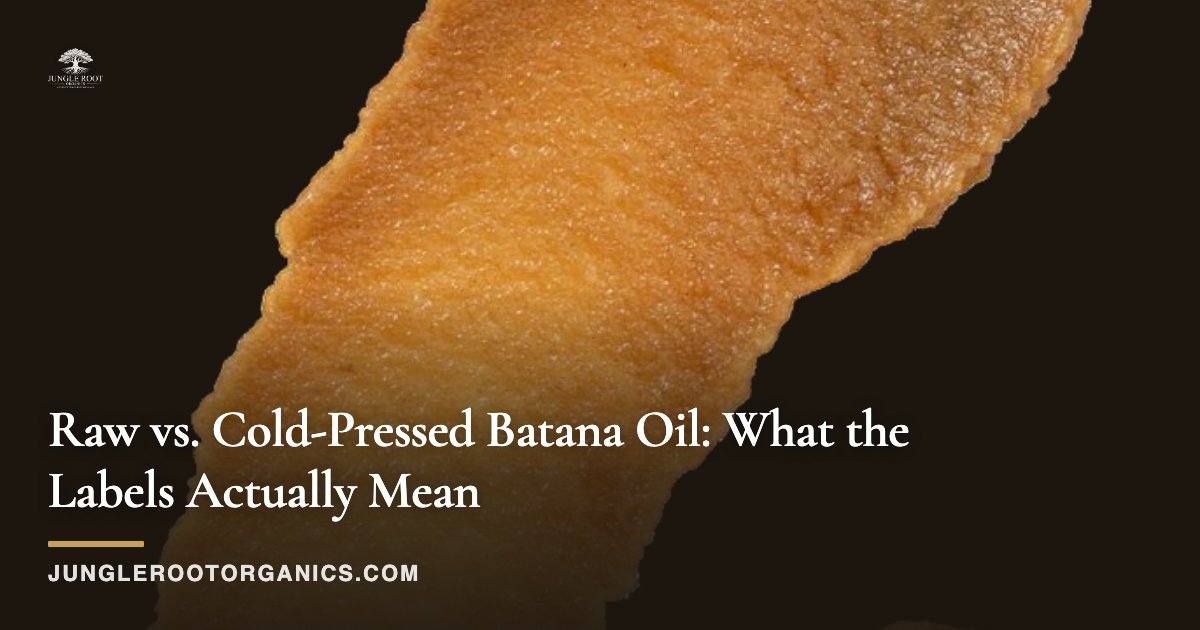
Buyers who have only seen product photography are often surprised by the first sample. Raw batana is very dark, from deep coffee to near-black. It is thick, often semi-solid at cool room temperature, and it softens and melts with the warmth of your hands. The aroma is roasted, smoky and nutty, closer to burnt coffee or toasted nuts than to anything floral.
Small amounts of natural sediment are normal. So is batch-to-batch variation in shade, viscosity and intensity of aroma, because the raw material and the fire are not standardized. Treat that variation as a signature of the process rather than a defect, and set your incoming specs with a range instead of a single point.
Oil that arrives pale amber, thin enough to pour like a serum at room temperature, odorless, and perfectly identical from lot to lot has almost certainly been refined, deodorized or blended with a lighter carrier. That is a legitimate product to sell, but it is not raw batana, and it should not be sold as if it were. Ours is available for evaluation through our product page.
How do you verify what you are actually buying?
Run this checklist on every batana supplier before you commit to a drum.
- Ask for the process in verbs, in writing. Ask them to describe extraction step by step. Vague answers, or answers that describe a press, tell you something.
- Ask directly what the oil is cut with. A straight question about carrier oils and additives deserves a straight yes or no in an email you can keep on file.
- Request the Certificate of Analysis and the technical data sheet before you order, not after. A supplier who cannot produce documentation for a wholesale volume is not a wholesale supplier.
- Confirm the botanical and INCI naming matches what you intend to print on your own label.
- Buy a paid evaluation sample and actually test it. Check color, aroma, sediment and how it behaves at cool room temperature versus on skin.
- Do a bench compatibility test in your intended formula before scaling, since a thick unrefined oil behaves differently from the refined version in emulsions and anhydrous blends.
- Ask about harvest seasonality and lead time. Anyone promising unlimited instant stock year-round is describing a warehouse, not a harvest.
What should your finished-product label say?
If you are buying raw batana and reselling it, borrow the accuracy, not the buzzword. The claims that hold up are raw, unrefined, 100% pure, and traditionally hand-processed. Every one of those is verifiable against your supplier documentation, and none of them requires you to describe a press that was never used.
Avoid cold-pressed entirely on raw batana. It is the single easiest claim for a knowledgeable customer, a retail buyer or a marketplace compliance reviewer to challenge, and you cannot support it with a COA. Copy that survives scrutiny is worth more than copy that ranks for a week.
Keep positioning cosmetic. Describe the oil, the origin, the process and the sensory experience. If you blend batana with a carrier for spreadability or scent, say so and name the carrier. Buyers who care enough to search for raw batana are exactly the buyers who will notice if you do not.
How do you order raw batana oil wholesale?
Our terms are straightforward. Wholesale begins at one drum, 33 to 75 gallons, and small-batch orders from 2 gallons ship free within the United States. Evaluation samples are paid: a 4 oz jar at $45 with shipping included, or a 1-gallon pail at $225 plus $35 US shipping, $260 delivered, credited toward your first drum order. We do not run an open free-sample program, because at this volume and labor cost it would be paid for by the customers who actually buy.
Certificate of Analysis and technical data sheet are provided to buyers, so you can match our specs against your formulation and documentation requirements before you commit. Lead time is generally one to two weeks depending on the season.
If you are comparing suppliers, the details that matter are on the wholesale buyers page. When you are ready to spec a batch or request a paid sample, get in touch and tell us your target volume and intended application.
Frequently asked questions
If heat is used during traditional processing, can the oil still be called raw?
Yes, because raw in this context refers to the absence of refining, not the absence of heat. Raw means no bleaching, deodorizing, solvent extraction or additives after extraction. The roasting and simmering are part of the traditional extraction itself, which is why raw and unrefined are accurate for batana while cold-pressed is not.
My current supplier calls their batana cold-pressed. Can I use that wording on my label?
We would not recommend it. If the oil was made the traditional way, the claim is inaccurate regardless of who wrote it first, and you are the one whose name is on the retail label. Ask your supplier to describe the extraction method in writing and label according to what they actually describe.
Why is some batana oil pale gold instead of near-black?
Pale, thin, odorless batana has usually been refined, deodorized or blended with a lighter carrier oil. Those products exist for formulators who want a neutral sensory profile. They are not the same input as raw batana, and they should be evaluated and priced as a different material.
How should raw batana oil be stored once the drum arrives?
Keep it sealed, cool, dark and dry, and keep water out of the container during transfer. Expect it to thicken or partly solidify in cool storage and to soften with gentle warmth, which is normal for the material. Refer to the technical data sheet we provide for the handling and storage parameters that apply to your batch.
Can I get a free sample before committing to a drum?
No. We offer paid evaluation samples only. The 1-gallon pail is enough volume to run real bench work rather than just look at the color, and a 4 oz jar is available if you need a smaller test size. If the sample checks out, we move to a standard order with the COA and technical data sheet on file.
Buying batana at volume?
Request wholesale pricing, our COA, and the technical data sheet.
Request wholesale pricing