Softening Point vs. Melting Point: Why Raw Batana Oil Arrives Soft
What is the melting point of batana oil?
The analytical melting point of raw batana oil is 46 to 47 C (roughly 115 to 117 F). That figure comes from measurement under controlled, steady heating, the way a lab determines it.
It is the temperature at which the fat fraction has fully turned liquid under test conditions. It is not the temperature at which the oil starts to look soft in your warehouse.
If you only see one number on a spec sheet, ask what method it describes. A melting point and a softening range are not interchangeable, and mixing them up causes most of the confusion buyers report.
What is the difference between softening point and melting point?
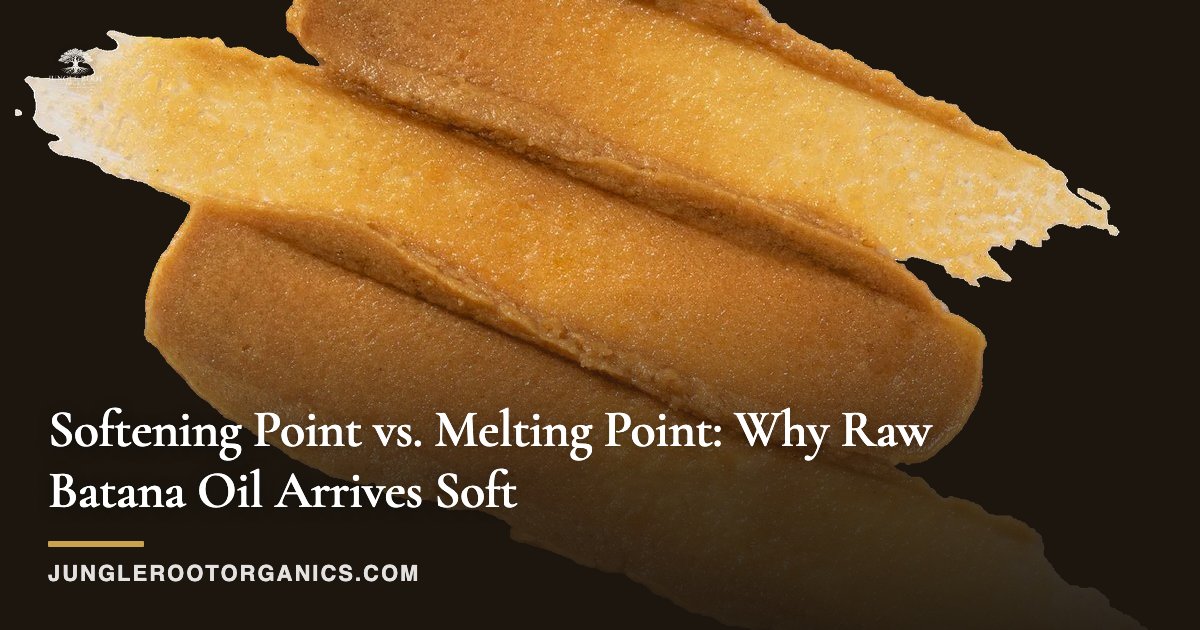
Raw batana oil is not a single pure compound. It is a natural mixture of fats, and those fats do not all change state at the same temperature. So the oil does not snap from solid to liquid at one line. It goes gradually through a range.
- Softening range, about 25 to 30 C at ambient: the oil loses its firm, buttery set and becomes pliable and spreadable.
- Noticeable liquefaction, from about 32 C: pooling and separation of liquid oil becomes visible in the container.
- Analytical melting point, 46 to 47 C: the controlled-heating figure where the oil is fully melted.
All three are true at once. One describes what you feel in your hands, one what you see on a warm day, and one what an instrument records.
Why does raw batana oil arrive soft if it melts at 46 to 47 C?
Because arriving soft only requires the oil to pass through its softening range, and that range sits inside the temperatures of an ordinary warm day. A pail or drum does not need to get anywhere near 46 C to look soft or partly liquid.
Our oil is raw, 100% pure and unrefined, and traditionally hand-processed. Nothing is added to stiffen it or to hold a particular texture at a given temperature. The texture you receive is the texture the oil naturally has at the temperature it sat at last.
Soft on arrival is therefore a physical property of the oil, not a quality warning.
Why do tropical shipments arrive soft or liquid?
The oil starts its journey in Honduras, and it travels through warm loading areas, trucks, and transfer points before it reaches a US dock. Any stretch above the softening range moves the oil toward soft, and any stretch above about 32 C pushes it toward visible liquid.
Season matters too. A summer shipment can spend hours in a trailer that is much hotter than the outside air. A winter shipment may arrive firmer, and sometimes grainy or set, depending on where it was stored.
This is also one reason lead time is 1 to 2 weeks depending on season. Planning around the weather is part of handling a natural oil responsibly.
Soft, liquid, or firm are all acceptable states. What you should check is that the oil looks and smells the way raw batana oil should, and that the documentation matches what you ordered.
How do you warm batana oil safely? A practical checklist
If you need the oil fluid for decanting, filling, or formulating, warm it gently. The goal is to even out the texture, not to cook the oil. For more on storage and day-to-day use, see our guides for buyers and brands.
- Let it rest first. Move the container to a room-temperature space and let it equilibrate before you apply any heat.
- Use indirect, gentle heat. A warm water bath or a controlled drum heater works. Direct flame or a hot plate under the container does not.
- Stay below about 47 C. Treat the melting point as your ceiling, not your target. Most jobs need much less.
- Check the temperature. Use a thermometer rather than guessing by touch.
- Stir slowly and fully. Warm the oil until uniform, then mix so that fractions and particles are evenly distributed.
- Fill promptly. Decant or fill while the oil is uniform, then let it cool in its final container.
- Avoid repeated heat cycling. Warm only what you need for the run.
Why do natural particles settle in raw batana oil?
Raw, unrefined oil that is traditionally extracted by hand keeps some fine natural material that a heavily filtered oil would not. When the oil is liquid or soft for a while, that material can drift down and settle at the bottom of the container.
This is normal for an unrefined product. It is not a sign that something went wrong in transit.
The fix is simple: warm gently as described above, then stir thoroughly before you draw any oil. If your product format needs a clear appearance, plan your filtering step with your own formulation in mind, and tell us when you ask about your volume so we can discuss it.
What should wholesale buyers check before ordering?
Treat the temperature behavior as a specification issue, not a surprise. Write the softening range and the melting point into your receiving notes so your warehouse and your co-packer read the same numbers.
Our Certificate of Analysis is an annual certificate based on representative sampling. If your quality program needs batch-specific testing, that is available on request at the buyer's cost. The technical data sheet is available to buyers as well.
Minimum order is one drum, 33 to 75 gallons, with flexibility for launching brands. We sell paid evaluation samples only, either a 1-gallon pail or a 4 oz jar for a smaller test, so you can see how the oil behaves in your own climate before committing. Start on our wholesale buyers page, review the product details, or contact us with your questions.
Frequently asked questions
Is it a problem if my batana oil arrives liquid?
No. Raw batana oil liquefies noticeably from about 32 C, so a warm shipment can easily arrive liquid. Check the appearance and aroma, stir well, and store it somewhere cool and stable.
Can I refreeze or refrigerate batana oil to firm it up?
You can let it set at cooler room temperatures, and it will firm up again on its own. Refrigeration is not needed for normal use. Whatever you do, mix the oil fully before use, because fractions can set unevenly.
What temperature should I never exceed when warming the oil?
Stay below about 47 C, which is the top of the analytical melting range. Most tasks only need the oil to reach a soft, pourable state, which takes far less heat than that.
Why do two shipments of the same oil look different?
Texture depends on the temperatures each shipment passed through and on the season, not on a change in the oil. One may be soft and smooth, another firmer or slightly grainy. For documented consistency, ask about batch-specific testing, available on request at the buyer's cost.
Does a lower softening point mean the oil is less pure?
No. Softening is a normal trait of a natural fat mixture. Our oil is strictly raw, 100% pure, and unrefined, and its documentation, including the annual Certificate of Analysis and technical data sheet, is available to buyers.
Buying batana at volume?
Request wholesale pricing, our COA, and the technical data sheet.
Request wholesale pricing