Working With Batana Oil's Texture: Warehouse and Formulation Handling Tips
Why doesn't batana oil have a fixed melting point?
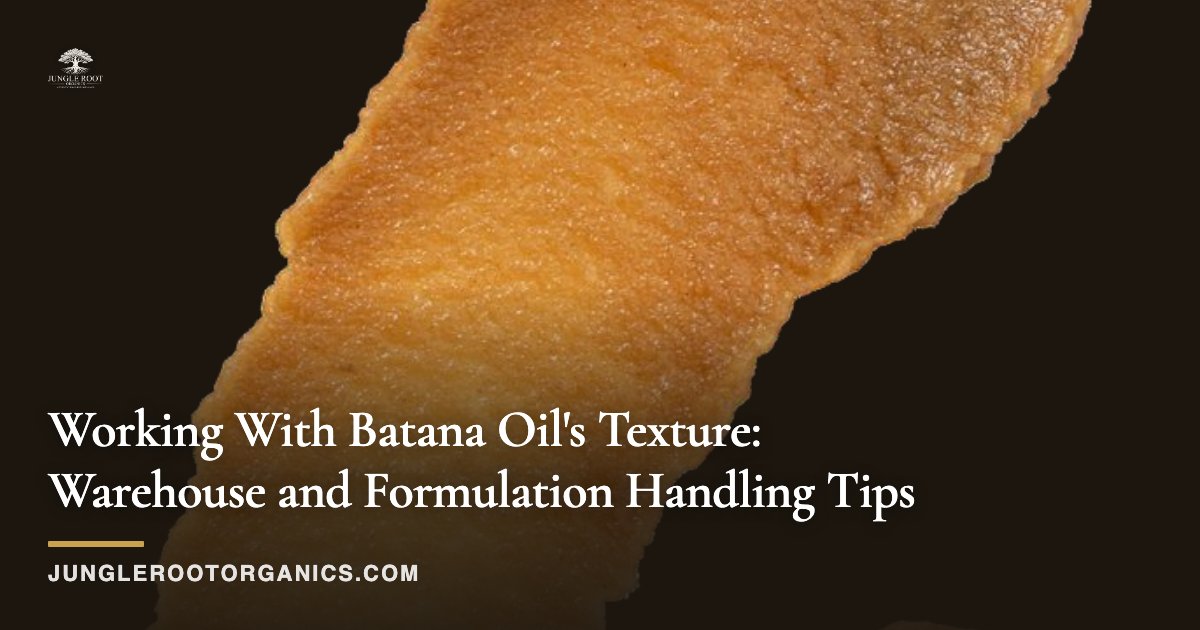
Most cosmetic oils buyers work with have been refined and standardized, so their melting behavior is predictable and consistent from batch to batch. Raw batana oil is different by design. It is not cold-pressed and goes through no refining step that would strip out or standardize the natural range of fatty compounds that give it structure.
That means the exact point where it softens or firms up can shift a little from lot to lot, the same way a fully natural butter behaves differently than a processed one. Instead of chasing a single number, treat texture as a range: solid or semi-solid in a cool room, softening as the room warms, and closer to pourable once it is gently heated.
If you are sourcing for a new formulation line, it is worth requesting a product sample and testing how that specific lot behaves in your own space before locking in a process.
How should batana oil be stored in a warehouse?
Store drums in a cool, stable area out of direct sunlight and away from radiators, loading dock doors, or anything else that swings the temperature around during the day. Consistency matters more than hitting a specific low temperature.
- Keep the drum sealed when not in active use to limit air and light exposure.
- Avoid stacking near heat sources like HVAC exhaust or sun-facing windows.
- Rotate stock on a first-in, first-out basis rather than letting older drums sit untouched.
- Keep drums off a cold concrete floor in winter if your facility swings hard between seasons, since a large temperature gap between the drum and the room can make the oil harder to work with when you open it.
Buyers setting up a wholesale supply chain for the first time can find more on order sizes and lead times on our page for wholesale buyers.
What's the safest way to gently warm the oil before use?
Use indirect, gentle heat rather than anything fast or direct. A water bath or a warming cabinet set low works well because it brings the whole container up to temperature evenly instead of overheating the oil closest to the heat source.
Skip the microwave and skip direct stovetop or flame contact. Uneven heating can scorch the portion nearest the heat while the rest stays solid, and it gives you no real control over how far you have gone.
Stir gently and periodically while it warms so the oil softens as a whole rather than in pockets. If you only need a small amount, it is often easier to scoop what you need and warm that portion separately rather than repeatedly reheating the full drum.
How do you homogenize batana oil into a formulation?
Because raw batana oil moves between solid and liquid states, getting a smooth, even blend usually comes down to matching temperatures before you combine ingredients, not forcing a cold, semi-solid oil into a liquid phase.
- Warm the batana oil gently until it is workable and pourable, using indirect heat as above.
- Bring your other oil or butter phases to a similar temperature before combining, so nothing seizes or forms lumps on contact.
- Mix at a steady, moderate speed rather than high shear, which can introduce air and affect the finished texture.
- Cool the blend slowly and evenly rather than rushing it into a refrigerator, which can cause uneven graining.
- Run a small test batch first any time you change your ratios or your heat source, since raw oils can respond a little differently than refined ones.
Formulators building out a new line can see current raw batana oil offerings on our products page.
Checklist: receiving and prepping a drum for production
A simple intake routine keeps texture handling consistent across your team and across seasons.
- Inspect the drum on arrival for a tight seal and no signs of leakage or damage.
- Log the receiving date and rotate stock so older drums get used first.
- Move the drum to its long-term storage spot away from heat and direct light as soon as it is inspected.
- Before opening for production, let the drum sit in a stable-temperature area rather than pulling it straight from an extreme hot or cold spot.
- Warm only the portion you need for that production run using indirect heat.
- Reseal the remaining oil promptly and return it to storage.
- Keep the Certificate of Analysis and technical data sheet on file with the batch so any texture questions can be checked against real documentation.
Need a copy of those documents for a specific lot? Contact us directly.
Does softening or hardening mean the oil has gone bad?
No. Batana oil moving between solid and liquid states on its own, in response to room temperature, is normal behavior for a raw, unrefined oil and is not a sign of a quality problem.
What is worth watching for is a change in smell over time, which is a better everyday indicator that something has shifted than texture alone. If anything about a batch smells off compared to what you have received before, that is the moment to reach out rather than guess.
We hand-process our oil traditionally and keep sourcing details in Honduras' La Mosquitia region deliberately private, but we back every batch with a Certificate of Analysis and technical data sheet so buyers are not relying on texture as their only quality check. You can read more about how we work on our our story page.
Frequently asked questions
Is batana oil solid or liquid at room temperature?
It depends on the room. In a cool space it tends to be solid or semi-solid, similar to a natural butter, and it softens as the room warms up. There is no single fixed state to expect, which is normal for a raw, unrefined oil.
Can I speed up melting with a microwave?
We do not recommend it. Microwaves heat unevenly, which can scorch or overheat the oil closest to the source while the rest stays solid. Indirect heat like a water bath gives you much more even, controllable results.
Does batana oil need to be refrigerated?
Not necessarily. A cool, stable room away from direct heat and sunlight is generally enough. Refrigeration will make the oil firmer and slower to work with, so plan extra warming time if you do store it cold.
Will melting and resolidifying the oil repeatedly damage it?
Repeated exposure to direct, high heat is worth minimizing, and gentle indirect warming is the safer habit to build. Scooping out only what you need for a given run, rather than reheating the full drum every time, helps limit unnecessary heat exposure.
How do I confirm a batch matches the specs I was quoted?
Ask for the Certificate of Analysis and technical data sheet for that specific lot, and consider ordering a paid 1-gallon evaluation sample before committing to a full order. Reach out through our contact page to request documentation for any batch.
Buying batana at volume?
Request wholesale pricing, our COA, and the technical data sheet.
Request wholesale pricing