Refined vs. Unrefined Batana Oil: What Bleaching and Deodorizing Remove
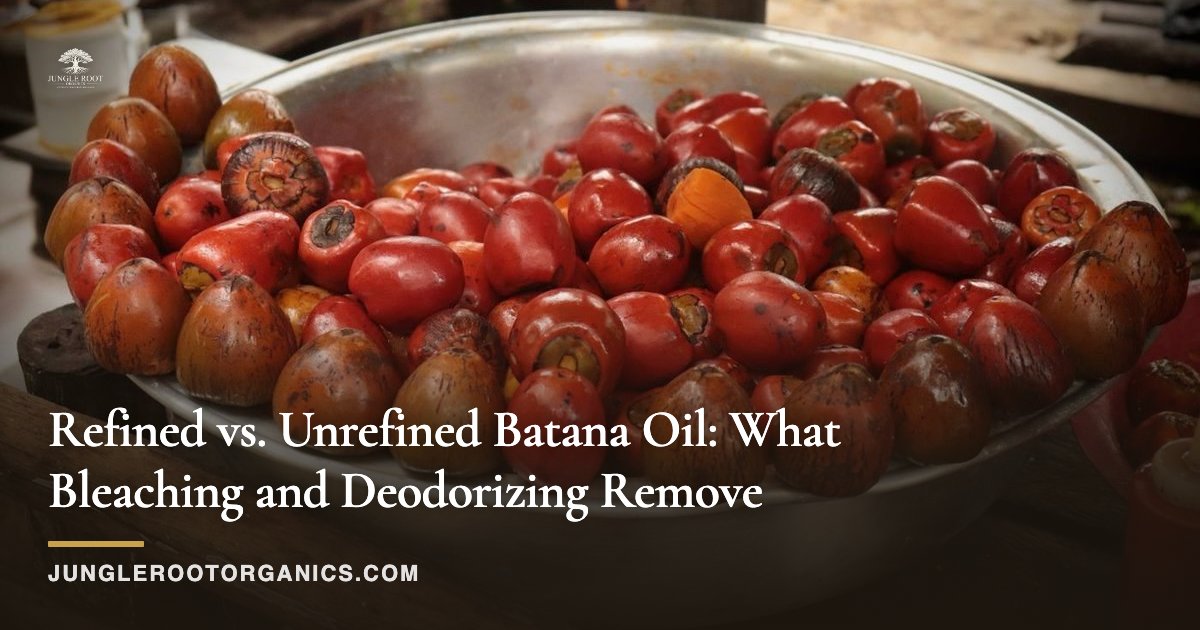
Refined batana oil has been through steps like degumming, neutralizing, bleaching and deodorizing. Those steps remove much of its deep red-brown color, its natural aroma and many of its carotenoids, leaving a pale, neutral oil. Unrefined batana oil skips them, so it keeps the color, scent and thick texture buyers recognize as batana.
What does refining actually do to a vegetable oil?
In the vegetable oil industry, refining is a series of processing steps applied after extraction. The goal is to make a crude oil neutral, pale and consistent. The usual sequence is degumming, neutralizing, bleaching and deodorizing, which is where the trade shorthand RBD (refined, bleached, deodorized) comes from.
Each step targets something specific in the crude oil. Together they strip out much of what makes an oil recognizable: its color, its smell, and many of the minor compounds that come along with the fats.
Unrefined batana oil skips all of that. After extraction it is packed, so what reaches your bench is the oil as it came off the process, with its natural color, aroma and texture intact.
What do degumming and neutralizing remove?
Degumming uses water or a mild acid to pull out phospholipids and gums, which can cause haze or sediment in storage. Neutralizing treats the oil with an alkali, which turns free fatty acids into soaps that are then washed or spun out.
For a commodity oil, these steps improve clarity and shelf behavior. They also start to move the oil away from its original character, because some minor components leave with the gums and soaps.
A related but separate issue is solvent extraction. That is an extraction method, not a refining step: a solvent such as hexane is used to pull more oil from the raw material. Solvent-extracted oils are usually refined afterward to remove leftover solvent and off-notes, so the two often come together.
What does bleaching take out of batana oil?
Bleaching in oil processing has nothing to do with household bleach. The oil is mixed with an adsorbent clay, often called bleaching earth, then heated and filtered. The clay traps pigments and oxidation products and holds them back.
With batana oil, the pigments are the point. Its deep red-brown color comes largely from carotenoids, and bleaching earth is designed to pull out exactly those. A bleached batana oil will be visibly lighter, shifting toward amber or yellow depending on how hard it was processed.
This matters commercially. Buyers who know batana expect the dark red-brown look, and a pale oil sold as batana immediately raises the question of what was done to it.
What does deodorizing change about scent and color?
Deodorizing is steam distillation under vacuum at high temperature. It strips out volatile compounds, which is where an oil's aroma comes from, along with any remaining free fatty acids.
Raw batana has a distinctive aroma that comes with traditional hand processing. Deodorizing flattens that toward neutral. The heat also breaks down carotenoids that survived bleaching, which is why fully refined oils from the palm family tend to come out pale and nearly odorless.
If your product is built around batana's identity, deodorizing removes the two things customers notice first: the color in the jar and the smell when they open it.
Should a formulator choose refined or unrefined batana?
Refined oils exist for good reasons. A neutral, pale oil is easier to add to a white lotion or a fragranced product without fighting its color or scent, and it tends to be more uniform from lot to lot.
Unrefined batana asks more of the formulator, but it gives more back to brands that position around the ingredient itself:
- Visible identity: customers who know batana recognize the red-brown color.
- Carotenoids retained: the pigments stay in the oil instead of ending up in spent bleaching clay.
- Supportable label language: you can back up raw, unrefined and virgin claims when the oil really has not been processed.
- Natural texture: raw batana thickens when cool. That is normal, but plan for it in filling and warehousing.
The trade-off is natural variation. Shade and aroma can change with harvest and season, so write your spec around ranges and evaluate real material before you commit.
How can you tell if batana oil has been refined?
Use this checklist on any batana oil you are considering, ours included:
- Look at the color. Raw batana is deep red-brown. Pale yellow or light amber suggests bleaching or blending.
- Smell it. A nearly neutral scent points to deodorizing.
- Check it cool. Raw batana thickens as it cools. Note how your sample behaves at room temperature and somewhere cooler.
- Ask direct questions in writing. Is the oil bleached, deodorized, solvent-extracted, diluted or blended? Get a yes or no for each one.
- Request the documents. Ask for the Certificate of Analysis, technical data sheet, SDS and certificate of origin. Check what the COA actually covers, including which sample was tested and when.
- Ask about batch testing. Find out whether batch-specific testing is available and who pays for it.
- Test a paid evaluation sample. Try it in your own base before you scale.
Our full document set is on the batana oil specifications and documents page. You can order a 4 oz jar or a 1-gallon pail from our evaluation samples shop.
What kind of batana oil does Jungle Root Organics supply?
We supply raw batana oil from Elaeis oleifera, the American oil palm, single origin from La Mosquitia, Honduras. It is 100% pure, unrefined and virgin. It is never bleached, deodorized, solvent-extracted, diluted or blended.
The oil is traditionally hand-processed and shipped direct from our mill in Honduras. Read more about how we source batana in La Mosquitia.
Formats run from a 4 oz evaluation jar and a 1-gallon food-grade pail up to a 25 kg trial pail and drums, and the oil is private-label ready. The minimum wholesale order is one drum, 33 to 75 gallons, with flexibility for launching brands. Lead time is 1 to 2 weeks depending on season. Wholesale orders ship with a certificate of origin, alongside our annual COA based on representative sampling and a per-lot batch document. Batch-specific lab testing is available on request at the buyer's cost. To get started, use the wholesale buyer inquiry form.
Buying batana for a product line?
Tell us what you make and the volume you need. We reply personally within 24 hours with wholesale terms, our Certificate of Analysis and the technical data sheet.
Questions buyers ask
Is unrefined batana oil the same as raw batana oil?
Usually they point to the same thing: oil that has not been bleached, deodorized or otherwise refined. Raw is often used to stress minimal handling. These labels are not standardized, so ask each supplier in writing what they mean by them.
Does refined batana oil still count as batana oil?
It comes from the same plant, but bleaching and deodorizing remove much of the color, aroma and carotenoids buyers associate with batana. Whether it suits you depends on your positioning. If your label says raw or unrefined, a refined oil will not support that claim.
Why does raw batana oil get thick when it is cool?
Thickening when cool is normal for raw batana and is not a sign of a problem. Plan for gentle warming before dispensing or filling, and consider storage temperatures in your warehouse and during transit.
Can I get a free sample to compare refined and unrefined oils?
We do not offer free samples. Paid evaluation samples are available as a 4 oz jar, or as a 1-gallon pail whose cost is credited toward your first drum order.
Does every batch come with its own Certificate of Analysis?
No. We provide an annual Certificate of Analysis based on representative sampling, plus a per-lot batch document. Batch-specific lab testing is available on request at the buyer's cost.