Why Serious Batana Suppliers Use Paid Evaluation Samples
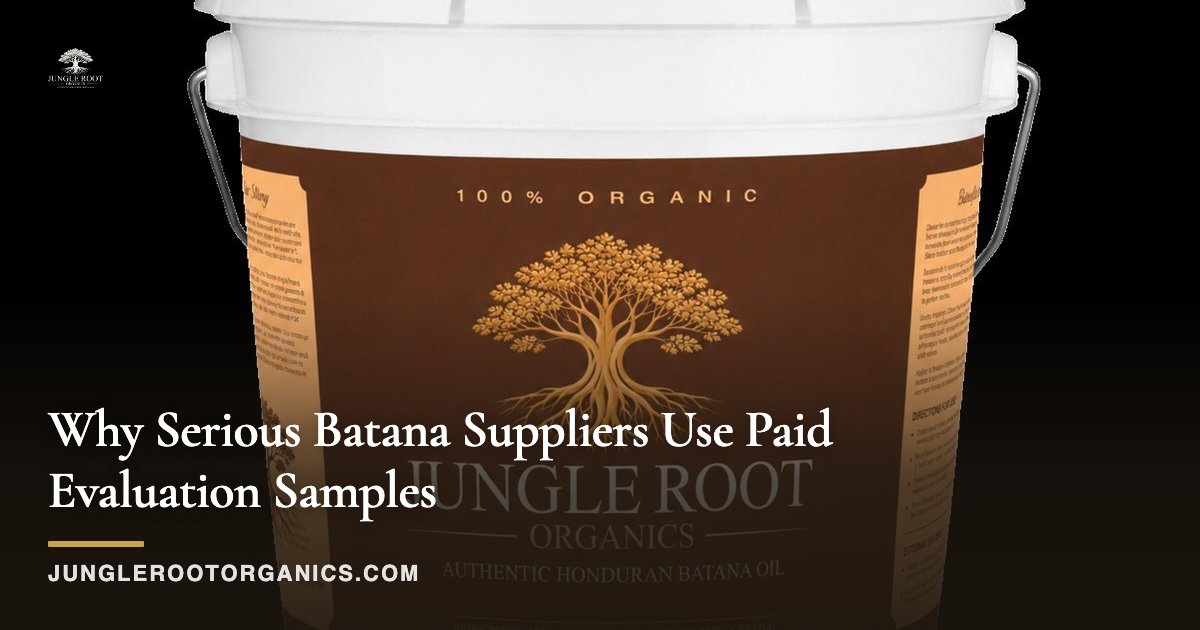
What does a paid batana oil sample actually buy you?
A 1-gallon evaluation sample is not a marketing gesture. It is a working quantity of raw batana oil pulled from inventory, enough to run bench trials, stability checks, fill pilot units, and hand product to a few testers without rationing every gram.
Compare that to the 10ml courtesy vial that free-sample programs send out. You can smell it and smear it on the back of your hand. You cannot heat it, blend it into an emulsion, watch how it behaves at 40C, or find out whether your pump dispenser can move it in January.
The paid model also means the sample comes from a lot that exists in a drum right now. What you evaluate is what ships. That single fact resolves most of the disputes that happen between a supplier and a first-time wholesale buyer.
Why do free samples usually mean a different oil than the one you buy?
Free-sample programs create a structural incentive problem. When a supplier gives away hundreds of vials a month with no revenue attached, the cheapest way to survive that cost is to fill them from a small, carefully chosen batch, or to source the sample material separately from the bulk supply.
Raw batana oil makes this worse, not better. It is a natural product that is hand-processed in Honduras, and lots vary in color, aroma intensity, and pour behavior at room temperature. A supplier who samples from one batch and ships from another is not necessarily lying to you. They just cannot promise continuity.
Charging for the sample removes the incentive to cheat. The sample is inventory, priced like inventory, drawn from the same lot you will be quoted on. Ask any supplier a direct question: is this sample from a lot you currently hold, and will you tell me the lot number? The answer separates the traders from the operators. Our approach is laid out in more detail on our wholesale buyers page.
How does the trip from Honduras change the economics?
Batana oil is not a commodity you pull from a warehouse three states away. It comes from La Mosquitia in Honduras, it is traditionally hand-processed, and the supply chain includes harvest seasonality, regional logistics, export documentation, and international freight before a drum reaches a US buyer.
Every gallon carries that cost. Breaking a sealed drum to fill a 1-gallon sample also has a real operational cost: you handle, decant, container, label, and ship a unit that will never be part of a bulk order.
Suppliers who absorb that cost for free are making it back somewhere. Usually it is in the bulk price, which means serious buyers subsidize tire-kickers. Pricing the sample honestly keeps the drum price clean.
Lead times reflect the same reality. Our typical lead time runs 1 to 2 weeks depending on season. A supplier who promises same-week shipment year-round on any quantity is either sitting on aging stock or has not thought about harvest timing.
What should you actually test with a 1-gallon evaluation?
Most buyers waste their first sample by treating it as a sniff test. Build a plan before the gallon lands, because the point of the evaluation is to answer questions that a data sheet cannot.
- Sensory baseline. Record color, aroma, and viscosity at a set temperature, in writing, with photos. This becomes your reference for every future lot.
- Cold behavior. Hold a portion at your warehouse's coldest realistic temperature. Raw, unrefined oil thickens. Know how yours behaves before a winter shipment surprises your fill line.
- Formulation trials. Run it at your intended inclusion rate in your actual base. Check emulsion stability, separation, and how it carries fragrance.
- Packaging compatibility. Test with your real closures, pumps, droppers, and liners. Run a fill trial at your intended viscosity and temperature.
- Accelerated aging. Set aside sealed retains under elevated temperature and track them against a room-temperature control.
- Consumer panel. Put finished samples in front of ten to fifteen real users and record how they describe the scent and skin feel. Their vocabulary becomes your label copy.
Document everything against the Certificate of Analysis and technical data sheet we provide to buyers. If your bench observations and the paperwork disagree, that is a conversation worth having before a drum ships.
How do you run a supplier evaluation without wasting three months?
A structured evaluation takes weeks, not quarters. Work through it in order and stop early when a supplier fails a step.
- Step 1. Ask for the Certificate of Analysis and technical data sheet before you pay for anything. A supplier who cannot produce documentation for a lot they claim to hold does not hold it.
- Step 2. Confirm the processing method in plain language. Raw batana oil is traditionally hand-processed and unrefined. It is not cold-pressed, and a supplier who uses that term interchangeably is describing something else or does not know their own product.
- Step 3. Order the paid 1-gallon evaluation and confirm the lot it is drawn from.
- Step 4. Run your bench and packaging trials on a fixed calendar. Two weeks of focused testing beats two months of drift.
- Step 5. Compute your own landed cost per finished unit. Take the drum price, divide by your usable yield after handling loss, multiply by your inclusion rate per unit, and add freight and duty. That number, not a headline per-gallon price, tells you whether the program works.
- Step 6. Confirm reorder terms, lead time, and continuity before you commit. Ask what happens if your volume triples.
You can see the current range on our products page, and start the process through contact.
What if you are launching and cannot commit to a full drum?
Wholesale begins at one drum, 33 to 75 gallons, and small-batch orders from 2 gallons ship free within the United States. Say so directly when you reach out. Tell us your projected first-run unit count, your inclusion rate, and your timeline, and we will tell you honestly whether a drum makes sense yet or whether you should evaluate now and buy later.
What we do not do is send free samples. That policy is not stinginess. It is the same reason we can quote a stable drum price and tell you exactly which lot you are testing.
If you want the background on how we source and why we hold the line on raw and unrefined, read our story.
Frequently asked questions
Can I get the sample cost credited toward a drum order?
Yes. The $225 of oil in a 1-gallon evaluation sample is credited toward your first drum order. The $35 US shipping line is not credited. Bring your projected volume and timeline to the conversation.
Is one gallon enough to run a real stability program?
Yes for most first-run cosmetic brands. A gallon supports bench trials, packaging compatibility testing, retains for accelerated aging, and a small consumer panel with material to spare. If you are formulating multiple SKUs at once, plan your allocation before you start rather than halfway through.
Why does raw batana oil look and smell different between lots?
It is a natural, unrefined, traditionally hand-processed product, so lot variation is expected rather than a defect. Refined oils look uniform because processing strips the variation out. Build your specification around a range you can live with, and use your first sample as the written reference point.
What documentation comes with a wholesale order?
A Certificate of Analysis and a technical data sheet are available to buyers. Request them during evaluation, not after the drum arrives, so your bench results and the paperwork can be compared while you still have decisions to make.
How far ahead should I place a reorder?
Plan around a 1 to 2 week lead time that shifts with the season, then add your own internal buffer for filling and QC. If you are running a promotion or a retail launch, tell us the date early so we can flag any seasonal tightness before it becomes your problem.
Buying batana at volume?
Request wholesale pricing, our COA, and the technical data sheet.
Request wholesale pricing