Batana Oil Wholesale: A Buyer's Guide for Brands and Formulators
What does buying batana oil wholesale actually involve?
Retail batana is sold in ounces. Wholesale batana is sold in drums, and almost everything about the transaction changes at that scale. You are no longer buying a finished product, you are buying an input that has to behave consistently across production runs, pass your own QC, and land in your warehouse on a schedule your fill line can plan around.
That means the questions shift. Instead of asking whether the oil works, you ask where it came from, how it was processed, what paperwork travels with it, and what happens when you reorder in four months. A supplier who can only answer the first question is a reseller, not a source.
Practically, a batana wholesale relationship has four moving parts: origin, processing method, documentation, and supply rhythm. Get clear answers on all four before you build a SKU around the ingredient. You can see how we structure ours on our wholesale buyers page.
Why is raw and unrefined the spec that matters, not cold-pressed?
This is where most batana sourcing goes sideways. Buyers arrive with a mental checklist borrowed from other carrier oils, and the first box on it says cold-pressed. Batana does not work that way.
Our batana oil is raw, 100% pure, and unrefined, traditionally hand-processed in La Mosquitia, Honduras. It is not cold-pressed, and any supplier describing their batana as cold-pressed is either mislabeling the process or repeating marketing copy they never verified. That single detail is a fast, reliable filter when you are screening a list of vendors.
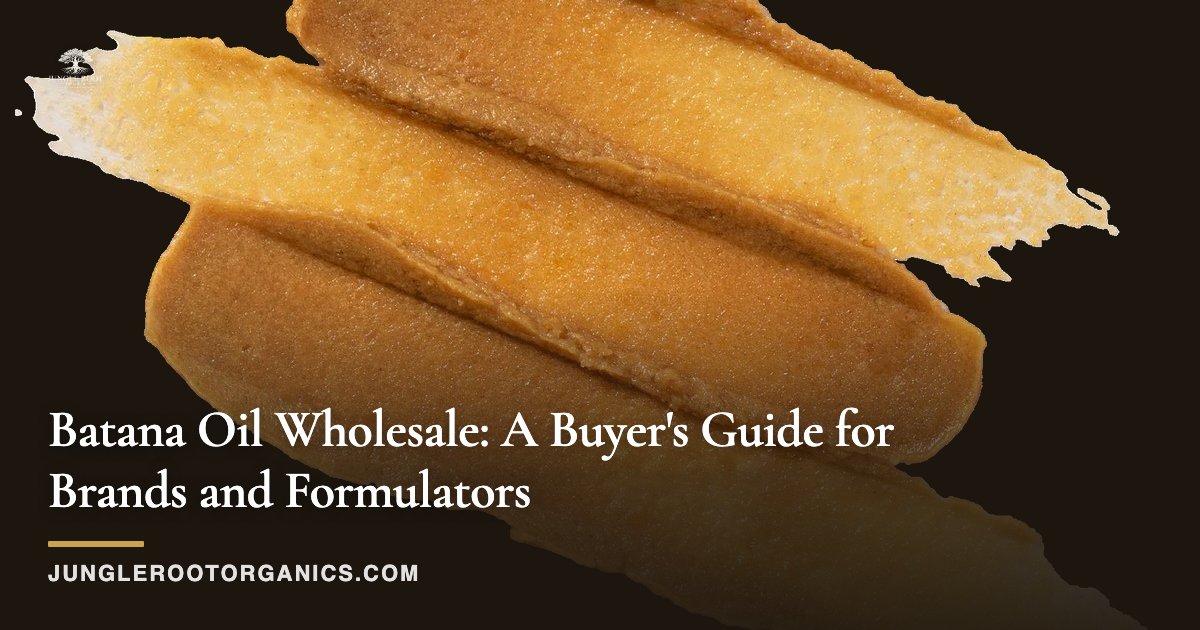
Raw and unrefined is the meaningful claim because it tells you what was not done to the oil: not bleached, not deodorized, not stripped down to a neutral base. That is why the material still carries its characteristic deep color and roasted, nutty aroma. If your brand story leans on traditional processing, the ingredient has to actually match it, because the first person to challenge you on it will be a customer, not a competitor.
How do you evaluate a batana sample before committing to a drum?
Order a paid evaluation sample and treat it like a real QC intake, not a sniff test. We supply paid 1-gallon evaluation samples, which is enough volume to run bench trials, a small pilot batch, and still have retain left over. We do not offer free samples, and a gallon is deliberately sized to let you make a real decision instead of a guess.
Work through this in order:
- Sensory baseline. Record color, aroma, and texture at room temperature. Photograph it. This becomes the reference you compare every future lot against.
- Warm and check behavior. Batana is thick and semi-solid at cool room temperature. Confirm how it handles at your actual filling and blending temperatures, not theoretical ones.
- Compatibility trials. Blend at your intended use levels into your base. Watch for separation, grittiness, or color shift over two to four weeks.
- Aroma load. Raw batana is assertive. Decide early whether you are working with that scent or fighting it with fragrance, because it drives your whole formulation approach.
- Stability hold. Keep retains at ambient and at elevated temperature. Check at 30, 60, and 90 days before you scale.
- Paperwork match. Read the Certificate of Analysis and technical data sheet against what is in the jar. They should agree.
Document each step with dates and lot references. When you reorder, that file is what turns a subjective impression into a specification.
What documentation should a batana supplier provide?
At minimum, a Certificate of Analysis and a technical data sheet, both available to buyers. The COA covers the lot you are actually receiving. The TDS covers the material in general: identity, appearance, typical handling and storage guidance, and the information your formulator and your regulatory reviewer will both ask for.
Read them together and look for consistency. A COA that does not reference a lot number is not a COA. A TDS that describes an oil visibly different from your sample is a signal that the paperwork came from somewhere other than the production it claims to describe.
Ask how documentation moves on repeat orders too. You want the COA to arrive with each shipment as a matter of routine, not as a favor you have to request every time. If you are assembling a supplier file for a retail or marketplace listing, that cadence matters more than any single document.
What are realistic MOQs and lead times for wholesale batana?
Our minimum order is typically one drum (33 to 75 gallons). For brands in the process of launching, we are flexible on that, because a company doing its first thousand units has a genuinely different volume profile than one reordering quarterly. Tell us what your first run actually looks like and we will work from that number.
Lead time is one to two weeks depending on season. That range is not a hedge. Batana is a traditionally hand-processed material, and production rhythm follows the season rather than a factory calendar. Plan your reorder point around the longer end of the range and you will never be caught short.
Two habits that save brands real money here: reorder when you hit roughly six to eight weeks of remaining cover rather than waiting for a low-stock alert, and place your first repeat order before your launch inventory is committed. Batana is not the ingredient you want to be sourcing under pressure. Our product details are here, and pricing is quoted per order.
How do you cost batana into a finished product?
We quote pricing directly rather than publishing it, because the number depends on volume, packaging, and destination. But you can build your cost model before you ever ask for a quote, and you should, because it tells you which quote actually works for your business.
Start from the drum. A 55-gallon drum holds roughly 7,040 fluid ounces. Divide that by the batana volume in a single finished unit to get your units per drum. A product using one half ounce of batana per unit yields about 14,000 units from one drum, before fill loss.
Then apply a realistic loss factor. Transfer, line purge, and retained product in totes and hoses will cost you something, and 3 to 5 percent is a sane planning assumption until you have measured your own line. Divide your delivered drum cost, landed freight and duties included, by your loss-adjusted unit count. That is your true per-unit batana cost, and it is the only number worth comparing across suppliers.
Run that math before you request a quote. It turns the conversation from a price question into a viability question, which is a much more useful thing to know. Learn where our oil comes from, or request pricing and a sample when you are ready to evaluate.
Frequently asked questions
Can I get a free sample of batana oil before ordering a drum?
No. We offer paid evaluation samples only: a 1-gallon pail, or a 4 oz jar if you need a smaller test size. A gallon is enough volume to run real bench trials, a pilot batch, and stability retains, which is the point. Free half-ounce samples tend to produce impressions rather than decisions, and at drum-scale commitments you need a decision.
Why does our batana oil look and smell different from a competitor's product?
Usually because one of them has been refined and the other has not. Raw, unrefined batana carries a deep color and a strong roasted, nutty aroma. Lighter color and a neutral scent generally indicate the oil has been processed to strip those characteristics out, or that it has been diluted with a carrier oil.
Does batana oil need to be stored or handled differently from other carrier oils?
It is thicker than most liquid carrier oils and firms up considerably at cooler temperatures, so plan for gentle warming before transfer or blending. Store drums away from direct heat and sunlight in a temperature-stable space. The technical data sheet available to buyers covers handling guidance in more detail.
What kinds of products is wholesale batana oil typically used in?
Cosmetic formulations, most commonly hair and scalp oils, balms, butters, and body products. Its thickness and strong natural aroma make it well suited to leave-in and treatment formats where texture and scent are part of the product identity. We position and supply it strictly as a cosmetic ingredient.
How far in advance should I place a repeat order?
Build your reorder trigger around a one to two week lead time that varies by season, then add your own transit and receiving buffer. Most brands we work with reorder at roughly six to eight weeks of remaining cover. That keeps you clear of the seasonal end of the range without carrying excess inventory.
Buying batana at volume?
Request wholesale pricing, our COA, and the technical data sheet.
Request wholesale pricing