Batana Oil for Haircare Brands: How to Source It for a Product Line
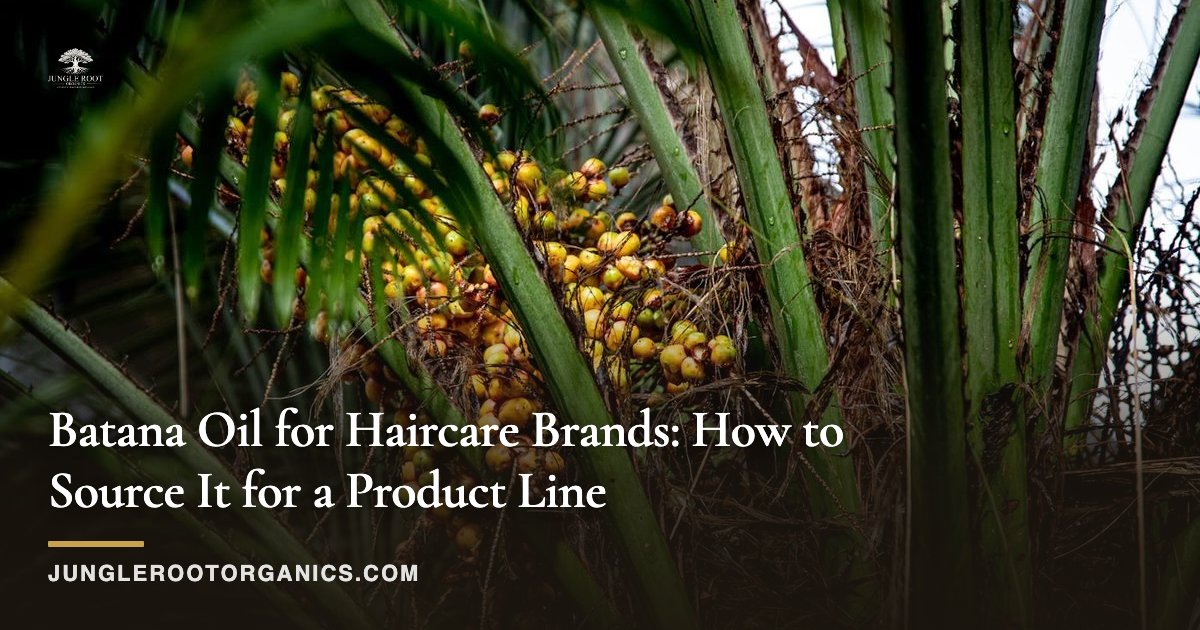
Haircare brands adding batana oil should first choose between a pure single-ingredient SKU and a blend. Then calculate the first order as batana fill weight per unit x units x overage factor. Buy raw, unrefined, single-origin oil that comes with a COA, technical data sheet, SDS, per-lot batch document and certificate of origin, and keep all marketing to cosmetic claims.
Should your batana SKU be pure oil or a blend?
Make this call first, because fill weight, packaging, price point and order size all depend on it. A pure batana SKU has one ingredient. The oil is deep red-brown, rich in carotenoids, and thickens when cool, so its texture shifts between solid and soft depending on room temperature. That honesty is what sells it, but your packaging has to work for a product that firms up.
A blend makes batana the hero ingredient alongside other oils, butters, or a full emulsion. You get control over how it spreads, smells and looks, and each unit uses less batana. In exchange, you take on more formulation work and stability testing.
- Choose pure if your brand story is about minimal ingredients and you want a short development timeline.
- Choose a blend if you need a pourable or pump format, a fragrance, or a lower cost per unit.
- Either way, start from oil that was not bleached, deodorized, diluted or blended at the source, so you decide what goes in the jar.
How do you keep batana oil consistent from lot to lot?
Raw batana is an agricultural product, so expect natural differences in color depth and texture between harvests. What you need to rule out is variation caused by processing shortcuts or adulteration. Our oil comes from a single origin in La Mosquitia, Honduras, is hand-processed in the traditional way, and is never refined or solvent-extracted. That removes the biggest causes of drift between lots.
Controls to set up on your side:
- Keep a retained sample from every lot you receive, labeled with its lot number.
- Run your own incoming check. Compare color, odor and texture at a fixed temperature against the retained sample from your approved lot.
- Match the per-lot batch document to the drum labels before anything goes into production.
- Order batch-specific lab testing if your retailer or QA program requires it. It is available on request at the buyer's cost.
Our page on how we source batana in La Mosquitia explains how the oil is made.
How much batana oil should you buy for a first production run?
Most first runs go wrong because brands order by gut feel. Use this formula instead:
Oil needed = batana fill weight per unit x number of units x overage factor
- Batana fill weight per unit: for a pure SKU, this is the full net fill. For a blend, multiply the net fill by batana's share of your formula.
- Units: your launch quantity, plus units for retail buyers, creators and stability testing.
- Overage factor: covers oil left on drum walls, in filler lines and in rejected units. Ask your filler for its actual loss history on thick oils and turn that into a multiplier.
A worked example with made-up numbers: a blend with a 50 g net fill where batana is half the formula uses 25 g of batana per unit. At 3,000 units and an overage factor of 1.10, you need 25 x 3,000 x 1.10 = 82,500 g, or 82.5 kg. Convert that weight to gallons using the density on the technical data sheet, then compare it with drum sizes.
Our minimum wholesale order is one drum of 33 to 75 gallons, and we are flexible for brands that are launching. If your number comes in well under a drum, a 25 kg trial pail or a 1-gallon food-grade pail can cover pilot batches and stability work first.
What documentation will retailers ask for?
Retail buyers, marketplaces and distributors will ask for paperwork before they list your product. Wholesale orders of our raw batana oil come with:
- Annual Certificate of Analysis based on representative sampling.
- Per-lot batch document that ties your drums to a specific production lot.
- Technical data sheet (TDS) for your formulator and your specification files.
- Safety Data Sheet (SDS) for warehousing, freight and your contract manufacturer.
- Certificate of origin confirming the oil comes from Honduras.
Describe these documents to retailers accurately. The annual COA is not a test of each batch. If a buyer needs batch-specific results, order that testing on the lot you will use and budget for it. The full list is on our batana oil specifications and documents page.
A step-by-step checklist for launching your first batana SKU
This is the order of steps we see work for brands adding batana to an existing line:
- 1. Order a paid evaluation sample. Get a 4 oz jar for bench work, or a 1-gallon pail that is credited toward your first drum order. Both are in our evaluation sample shop.
- 2. Lock the format. Decide on pure or blend, jar or tube, and the net fill weight.
- 3. Run stability and compatibility tests in your final packaging, including how the oil behaves when cool.
- 4. Collect the documents (COA, TDS, SDS, certificate of origin) and check them against your retailer's vendor requirements.
- 5. Do the quantity math and round up to the nearest practical drum or pail size.
- 6. Plan for lead time. Expect 1 to 2 weeks depending on season, plus freight time and your filler's schedule.
- 7. Keep retained samples from the production lot and file the batch document with your batch records.
If you plan to sell under your own label, tell us when you first inquire so packaging and labeling are planned from the start. Our oil is private-label ready.
How should you position batana oil on labels and product pages?
Position batana as a cosmetic ingredient and stay there. Describe what customers can see and feel: the deep red-brown color, the rich texture, the single origin in La Mosquitia, and the fact that the oil is raw and unrefined. You can document all of these claims.
Keep medical or drug-like claims off labels, product pages and social posts. Retailers screen for them, and in many markets they can turn a cosmetic into a regulated drug. Train your creators and sales reps on the same rules, because their captions count too.
Origin is a strong story you can defend. Back it up with the certificate of origin and the traditional hand-processing, and skip vague hype words that draw scrutiny.
When you are ready to plan a first order, send your volumes through our wholesale buyer inquiry form.
Buying batana for a product line?
Tell us what you make and the volume you need. We reply personally within 24 hours with wholesale terms, our Certificate of Analysis and the technical data sheet.
Questions buyers ask
Can I sell this batana oil under my own brand?
Yes. Our raw batana oil is private-label ready and goes to haircare brands, salons and distributors who sell it under their own names. Tell us at the inquiry stage so packaging and labeling are planned early.
Do you offer evaluation samples?
Yes, evaluation samples are paid. You can order a 4 oz jar for bench testing or a 1-gallon pail, and the pail is credited toward your first drum order. This lets your formulator work with the same oil you will buy at scale.
Why does raw batana oil turn solid in a cool room?
Raw, unrefined batana naturally thickens when cool. This is a normal property of the oil, not a quality problem. Test your chosen packaging at the temperatures your product will meet in warehouses and bathrooms, and include usage directions if customers may need to warm it slightly.
Do you ship to importers outside the United States?
Yes. We work with international importers and ship direct from our mill in Honduras. Wholesale orders include a certificate of origin, which customs brokers and importers usually need.
What is the difference between raw and refined batana for a formulator?
Raw batana keeps its natural deep red-brown color, carotenoid content and characteristic aroma. Refining usually means bleaching and deodorizing, which strips those out. Our oil is never bleached, deodorized, solvent-extracted, diluted or blended, so the formulator decides how to work with its natural character.