Where Batana Oil Really Comes From: La Mosquitia, Honduras
What plant does batana oil actually come from?
Batana oil comes from the kernel of Elaeis oleifera, the American oil palm. It is native to the Americas and is a different species from the African oil palm that supplies the global commodity palm oil trade. Same genus, very different plant, very different oil.
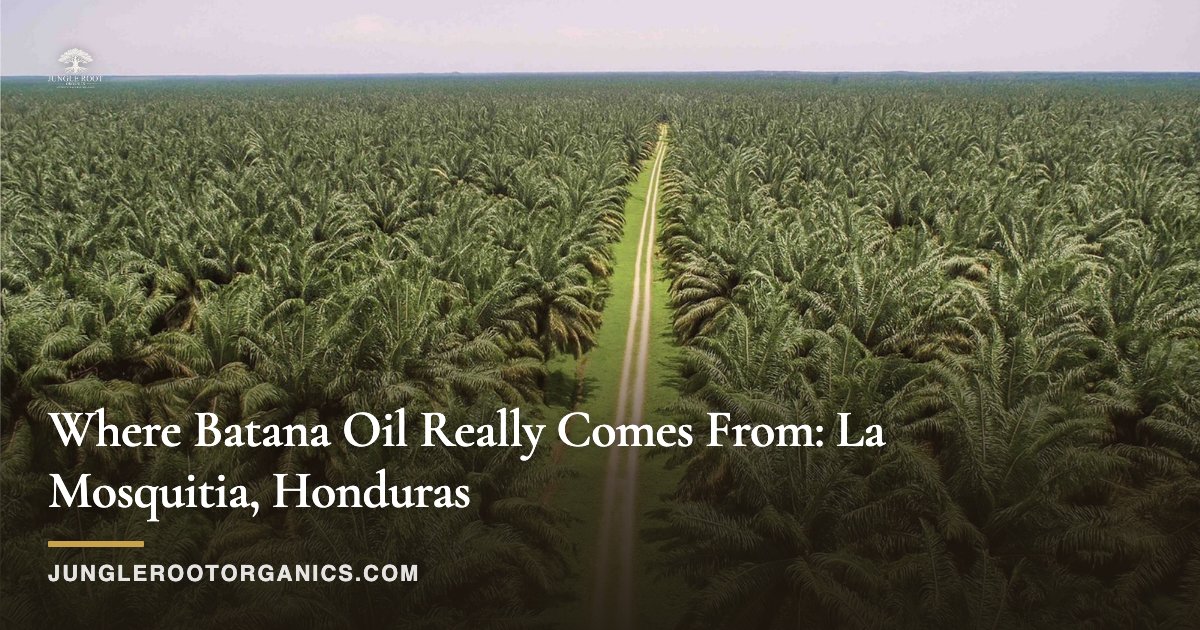
In Honduras the palm is usually called the batana or ojon palm, and the oil takes its name from it. The trees grow in wet lowland forest and along river systems, often in mixed wild stands rather than planted rows. Harvesters walk to individual trees and cut ripe bunches by hand.
That botanical detail matters commercially. When a buyer asks for batana oil and receives something pale, thin and odorless, the first question is not whether it was filtered aggressively. The first question is whether it came from Elaeis oleifera at all, or from a refined African palm kernel fraction sold under a trendier name.
Why does La Mosquitia matter to the quality of the oil?
La Mosquitia is the large, roadless rainforest region of eastern Honduras that runs toward the Caribbean coast and the Nicaraguan border. It is where the palm grows densely enough, and where the processing knowledge has been carried far enough, for batana to exist as a real trade good rather than a curiosity.
The region is home to the Miskito people along with other Indigenous and Afro Indigenous communities, and the hand-processing method associated with batana is part of that living practice. It was not designed for export. It was designed to produce a useful oil with fire, water, a mortar and patience.
Terroir here is less about flavor chemistry and more about supply reality. Wild and semi-managed stands ripen on their own schedule, access is by river and footpath, and output is limited by how many hands are working, not by how many hours a plant can run. That is the honest reason genuine raw batana is not a commodity you can order in unlimited volume next week. You can read how we approach that on our story page.
How is traditional batana oil made by hand?
The traditional method is a heat and water process, done in stages over several days. The broad sequence looks like this:
- Ripe fruit bunches are cut and carried out of the forest
- The fruit is softened in water so the pulp can be worked off the nut
- Nuts are dried, then cracked by hand to free the kernels
- Kernels are roasted and ground to a dark paste
- The paste is boiled in water so the oil separates and rises
- The oil is skimmed, then settled and strained
Every one of those steps is manual. There is no press, no expeller and no solvent anywhere in the chain. That is why the finished oil carries a deep coffee to near black color and a distinct roasted, smoky aroma. Both come directly from the roast and the boil.
It is also the precise reason authentic batana oil is never cold-pressed. Cold-pressed describes a mechanical press run below a temperature threshold. Batana is not pressed. A supplier who uses the term on a batana spec sheet is either copying language from a sunflower oil listing or does not know their own process.
What does raw and unrefined actually change in the drum?
Raw and unrefined means the oil never went through bleaching, deodorizing, winterizing or solvent extraction. Nothing was stripped out to make it easier to formulate with, and nothing was added back.
Practically, that gives you an oil with real working characteristics you need to plan around:
- Color: very dark, and it will tint a leave-in, a balm or a light cream
- Aroma: roasted and smoky, strong enough that your fragrance brief has to account for it
- Texture: thick and buttery at room temperature, loosening with warmth
- Sediment: a small amount of natural settling is normal in an unrefined oil
None of that is a defect. It is what the category is. The mistake we see most often is a brand writing marketing copy about pure unrefined batana while its formulation team quietly asks for something clear and scentless. Decide which product you are actually building before you buy a drum. Our product page lists what we stock and the documentation that ships with it.
How do you verify a batana oil's origin before you buy?
Origin claims are cheap. Documentation and consistency are not. Run this checklist on any supplier, including us:
- Ask for the Certificate of Analysis and technical data sheet before you commit, not after the drum lands
- Ask which species the oil comes from and expect the answer Elaeis oleifera, not a vague reference to palm
- Ask how it is processed. If the answer includes cold-pressed, expeller-pressed or refined, it is not traditional raw batana
- Buy a paid evaluation sample first and check color, aroma and texture against the spec sheet in your own lab
- Ask about harvest seasonality and current lead time, then compare that answer to your launch calendar
- Ask what happens on reorder and whether the supplier can hold the same profile across lots
One more test worth running: do your own volume math before you negotiate. A 55-gallon drum is roughly 208 liters. Convert to milliliters, divide by your intended fill size, then subtract whatever your filling line genuinely loses to transfer and headspace, which you should measure on your first run instead of guessing. That number tells you how many finished units a drum supports and whether your MOQ conversation is a real constraint or an imagined one. We walk buyers through this on the wholesale buyers page.
What should you plan for when ordering from a wild-harvest chain?
Wild harvest behaves differently from a plantation crop, so build your timeline around it rather than fighting it.
Our minimum order is typically one drum (33 to 75 gallons), with flexibility for brands still launching. We sell paid evaluation samples only (a 1-gallon pail, or a 4 oz jar for a smaller test) and do not send free samples, which keeps sample volume going to teams who are actually formulating. Lead time runs one to two weeks depending on season.
If you have a hard launch date, place the reorder before you need it and treat harvest season as a variable in your inventory model. Brands that get burned are almost always the ones that ordered their second drum the week they ran out of the first.
Why won't a serious supplier name the exact community it buys from?
Public sourcing stories that name specific villages and families tend to serve the brand telling the story more than the people named in it. It invites buyers to go around the relationship, and it puts a spotlight on small producers who did not ask for one.
We say where the oil comes from, which is La Mosquitia in Honduras, and we say how it is made. We do not publish the names of the people we buy from.
What we do put in writing is the part you can actually audit: species, processing method, Certificate of Analysis, technical data sheet and lot consistency. A romantic origin paragraph proves nothing about what is in the drum. Documents do. If you want to see ours, get in touch and tell us what you are formulating.
Frequently asked questions
Is batana oil the same thing as ojon oil?
In practice, yes. Both names refer to oil from the American oil palm, Elaeis oleifera, and ojon is a common regional name for the same palm in Honduras. Ojon was also popularized as a cosmetic brand name, which is why the two terms circulate side by side in the market.
Can batana oil be produced outside Honduras?
The palm grows in parts of Central and South America, so oil from the species is not geographically impossible elsewhere. What is concentrated in La Mosquitia is the traditional hand-processing practice and the trade infrastructure around it. Oil sold as batana from other regions deserves the same species and process questions you would ask anyone.
Why is raw batana oil so dark and strongly scented?
The color and aroma come from roasting the kernels and boiling the paste, both core steps in the traditional method. Refining would lighten and deodorize it, but that also removes the character buyers are asking for when they specify raw. If a batana sample arrives pale and neutral, ask what was done to it.
Does the oil solidify or thicken in transit?
Raw batana is naturally thick at room temperature and will firm up further in cold conditions, which is normal for an unrefined oil and reverses with gentle warming. Plan your winter receiving and decanting around it. A small amount of natural sediment is also expected rather than a sign of contamination.
Do you sell free samples so we can test before committing?
No, we offer paid evaluation samples only: a 1-gallon pail, or a 4 oz jar if you need a smaller test size. A gallon is enough to run real bench work, stability trials and a pilot batch rather than just a sniff test. If the evaluation goes well, the standard next step is one drum (33 to 75 gallons), with flexibility for brands still getting to launch.
Buying batana at volume?
Request wholesale pricing, our COA, and the technical data sheet.
Request wholesale pricing