Private-Labeling Batana Oil: From Bulk Drum to Branded Jar
What does private labeling batana oil actually involve?
Private label means the oil is made by someone else and sold under your name. You are not formulating, you are sourcing, filling, labeling, and selling. For a single-ingredient product like raw batana oil, that shortens the chain considerably: there is no emulsion to stabilize, no preservative system to challenge test, no fragrance house to brief.
The chain looks like this. Bulk raw oil arrives in a drum. You or a contract filler warms and decants it into retail containers. Your printed labels go on. Your finished goods ship to a 3PL or your own garage, and you sell.
What you are actually taking on as the brand owner is responsibility for the product on the shelf. The label, the claims, the safety file, the customer who emails you about a reaction. That is why the sourcing decisions in the next two sections matter more than they look.
What do you actually get in a bulk drum of raw batana oil?
Our oil is raw, 100% pure, and unrefined, sourced from La Mosquitia in Honduras and hand-processed using traditional methods. It is not cold-pressed, and it should never be described that way on your label or in your copy. Raw batana is produced by a heat-based traditional process, and that process is exactly what gives the oil its dark color and roasted, nutty aroma.
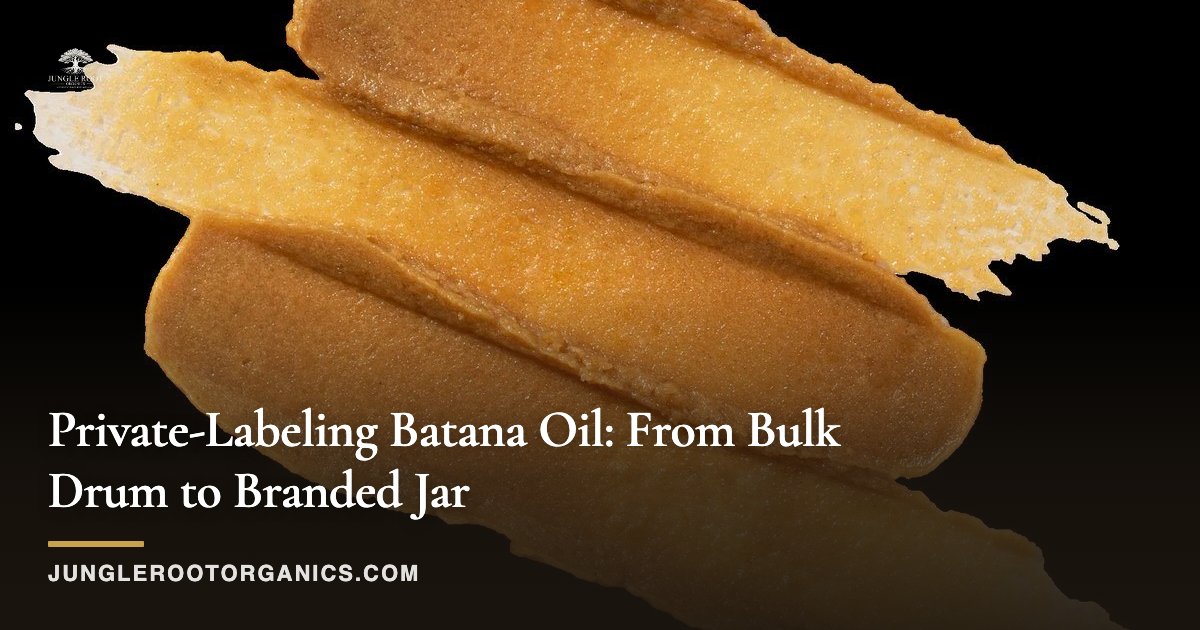
Expect a product that behaves like a butter, not a liquid oil. At cool room temperature it is thick to semi-solid. It softens in a warm room and melts on contact with skin. Color runs dark brown to near black, and the scent is smoky and distinctive. First-time buyers sometimes flag these as defects. They are the fingerprint of unrefined oil.
Every buyer gets access to a Certificate of Analysis and a technical data sheet. Read both before you write a single line of packaging copy. Those two documents are the evidence base for everything you are allowed to say. You can review current bulk specs on our products page, or go straight to the wholesale buyer details.
How many units does a drum make, and what packaging holds up?
Do this math yourself before you commit to a container size. A 55-gallon drum is roughly 208 liters. Divide by your fill size to get a ceiling on unit count: at a 50 mL fill that is about 4,160 units, at 100 mL about 2,080, at 236 mL (8 fl oz) about 880. Then subtract for headspace, transfer losses, drum residue, and QC rejects. Confirm net contents with us rather than assuming, and check your own filling losses on a small trial run.
That ceiling number is the reality check most founders skip. Four thousand jars of a single SKU is a real inventory position. Larger fills move a drum faster with less labor per unit.
Packaging notes from what actually works with a thick, dark, aromatic oil:
- Wide-mouth glass jars are the default. Customers scoop this product, they do not pour it. A narrow neck makes the last third unusable.
- Amber or opaque glass protects against light and hides the color variation that is normal between batches.
- Aluminum tins ship lighter and survive drops, which matters if you sell direct to consumer and eat the breakage.
- Liners and seals should be compatible with oils. Induction seals reduce leak claims in transit.
- Squeeze bottles and pumps usually disappoint. The oil sets up firm in a cold warehouse and clogs.
We keep a packaging options sheet and can send it with your quote. Ask for it when you get in touch.
What goes on a cosmetic label in the US?
General pointers only here, not legal advice. Get a regulatory consultant or attorney to review your artwork before it goes to print, because a reprint after a compliance problem costs far more than the review did.
A US cosmetic label is generally expected to carry an identity statement saying what the product is, the net quantity of contents in both metric and US customary units, an ingredient declaration in descending order of predominance using INCI names, and the name and place of business of the manufacturer, packer, or distributor. Warnings and directions appear where they are needed.
For a single-ingredient product the ingredient line is short, but get the INCI name right rather than printing a marketing name. Batana is commonly declared under the INCI for the oil palm species it comes from, and you should confirm the exact wording against current INCI listings for your product.
Beyond the label itself, US cosmetics regulation now includes obligations around facility registration, product listing, naming a responsible person, adverse event recordkeeping, and holding safety substantiation on file. Build that file as you go. Reconstructing it under pressure is miserable.
Which marketing claims can a COA actually support?
A COA supports identity and quality claims. It does not support outcome claims. That distinction is the whole game.
Claims your documents can back, assuming they match what you received: that the oil is raw, unrefined, and 100% pure with no fillers or carrier oils, that it is single origin from La Mosquitia in Honduras, that it is traditionally hand-processed, and that it meets the specification on file. Those are verifiable statements about a material.
Claims to keep off your packaging: anything that says or implies the product treats, prevents, or cures a condition, regrows hair, or affects the structure or function of the body. Those read as drug claims regardless of your intent, and they are the fastest way to turn a cosmetic brand into a regulatory problem. Keep your positioning cosmetic: appearance, feel, conditioning, tradition, sourcing.
Also resist the urge to invent numbers. A percentage with no test behind it is worse than no percentage. If you want data-backed copy, commission your own testing on your own finished product and cite that.
Drum to shelf: a step by step checklist
- Order a paid 1-gallon evaluation sample. We sell evaluation samples rather than giving them away, and one gallon is enough to test fills, run stability in your actual packaging, and put product in front of testers. We do not offer free samples.
- Read the COA and technical data sheet. Note anything you plan to reference in copy, and keep both in your product safety file.
- Choose fill size and container. Run the drum math above so you know your unit ceiling before you buy 5,000 jars.
- Trial fill by hand. Warm a small quantity, fill ten units, seal them, and leave some cold and some warm for a few weeks. Watch for leaks, separation, and how the product looks after a temperature swing.
- Draft artwork, then get it reviewed. Identity, net contents, INCI ingredient line, responsible party, any warnings.
- Line up filling and 3PL. Confirm your filler can handle a semi-solid butter and has a way to warm and hold the drum.
- Place the bulk order. Minimum is typically one drum (33 to 75 gallons), with flexibility for brands that are still launching.
- Plan around a 1 to 2 week lead time, which varies by season, and add your own buffer for filling, labeling, and inbound freight to your warehouse.
How long does a first production run really take?
Our side is short. Lead time on bulk runs 1 to 2 weeks depending on season, plus freight. The parts that stretch are the ones you control: artwork revisions, label printing, container lead times from your packaging supplier, and the filler's schedule.
A realistic first-run plan puts sample evaluation and packaging trials well ahead of the bulk order, so the drum is not sitting in your warehouse waiting on a label proof. Founders who sequence it the other way pay for storage and lose weeks.
If you are scoping a launch and want the bulk specs, the packaging options sheet, and current lead times in one reply, tell us your target fill size and expected first-year volume. You can read more about where the oil comes from on our story page, or start a conversation from the Jungle Root Organics home page.
Frequently asked questions
Can I get a free sample before ordering a drum?
No. We offer paid evaluation samples only: a 1-gallon pail, or a 4 oz jar if you need a smaller test size. A gallon is deliberately sized to be useful: it is enough oil to run trial fills, test your packaging through a temperature cycle, and put product in front of real testers before you commit to bulk.
Do you fill and label the jars for me?
We supply the bulk raw oil and can send a packaging options sheet on request. Filling and labeling are typically handled by you or a contract filler you appoint. Tell us your target fill size and container type and we can talk through what has worked for other brands.
Why does my batana oil look and smell different from another batch?
Raw, unrefined, traditionally hand-processed oil varies. Color, firmness, and aroma intensity shift with harvest and season, which is a normal characteristic of an unrefined single-ingredient material rather than a defect. If a batch looks outside what you expected, compare it against the COA for that lot and contact us.
Can I say my product is cold-pressed if I market it as premium?
No. Our batana oil is raw and unrefined but it is not cold-pressed, and describing it that way would be inaccurate on your label and in your advertising. Lead with raw, unrefined, 100% pure, single origin, and traditionally hand-processed instead, which is both accurate and more distinctive.
What paperwork should I keep on file as the brand owner?
Keep the COA and technical data sheet for every lot you receive, your supplier records and invoices, your finished-product artwork versions, and any safety substantiation and testing you commission. If you receive a customer complaint, log it. Building this file as you go is far easier than assembling it retroactively.
Buying batana at volume?
Request wholesale pricing, our COA, and the technical data sheet.
Request wholesale pricing