How to Evaluate a Batana Oil Sample Before a Bulk Order
What Is a Batana Oil Sample Actually Supposed to Prove?
A sample exists to answer one question: will this oil behave the same way at 50 gallons as it does in a jar on your desk. That means the sample has to be treated as a stand-in for the whole drum, not as a quick curiosity check.
Before you request one, know what you are testing it against. If you are formulating a hair or skin product, you need to know how the oil performs in your base. If you are reselling it raw, you need to know it matches what your customers expect batana oil to look and smell like. Browse our products to see the form factors available before you decide what to request.
Treat the sample evaluation as the first checkpoint in a sourcing relationship, not a formality you rush through to get to the order form.
Why Pay for a Sample Instead of Getting One Free?
We do not offer free samples, and that is deliberate. A paid sample, a 1-gallon pail or a 4 oz jar for smaller tests, is pulled from the same production stock that goes into a full drum. There is no separate, nicer batch set aside to win your business.
Free samples create an incentive to send out a best-case batch that has nothing to do with what ships later. Paying for the sample removes that incentive and gives you a true read on what a bulk order will actually look like.
If you are weighing supplier options as a new or growing brand, this is one of the clearest signals to look for. Our page for wholesale buyers covers minimum order sizes and lead times so you can plan the sample stage into your timeline, which generally runs 1 to 2 weeks depending on the season.
What Should Raw, Unrefined Batana Oil Look, Smell, and Feel Like?
Genuine raw batana oil is strictly raw and unrefined, never cold-pressed. It is traditionally hand-processed, and that process leaves fingerprints you can check for.
- Color: expect a deep green-brown to olive tone. Some batch-to-batch variation is normal with a raw, unrefined product, but wild swings in color from the same supplier are worth questioning.
- Scent: earthy and nutty, sometimes slightly smoky. It should not smell rancid, sour, or like it has been masked with added fragrance.
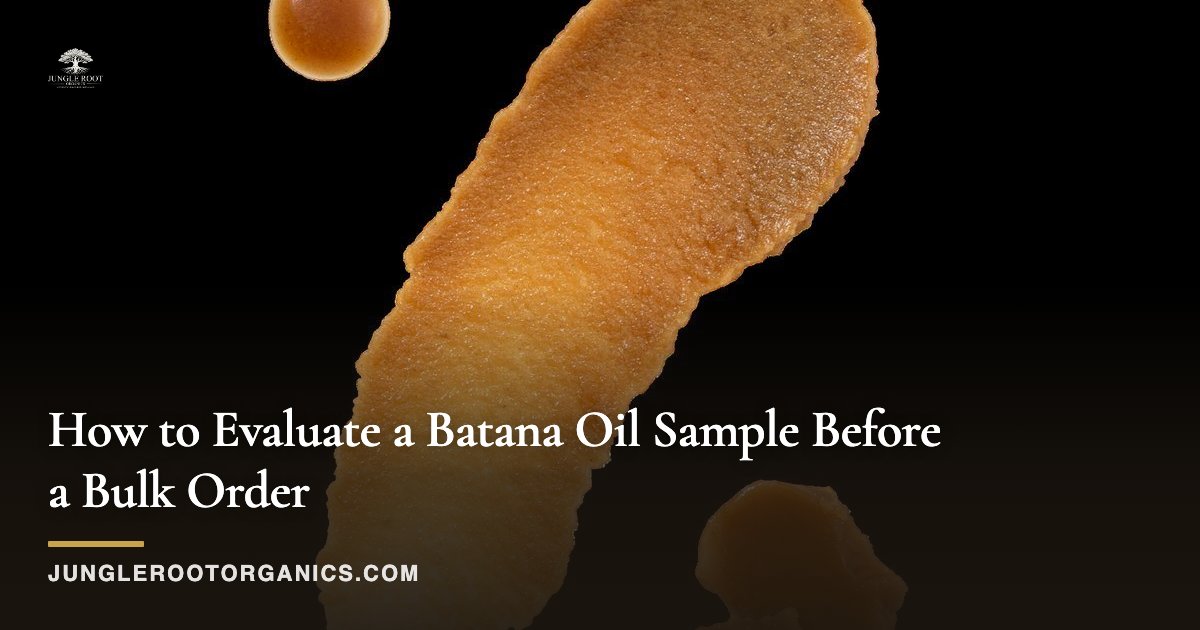
- Texture: a soft, waxy solid at room temperature that softens and melts on contact with skin. It should not be a thin, pourable liquid, and it should not be hard and crumbly.
If you want a deeper reference on sourcing and processing before you evaluate, our guides cover the background in more detail.
What Is the Step-by-Step Protocol for Evaluating a Batana Oil Sample?
Run the same checklist every time so you are comparing apples to apples across suppliers or batches.
- Visual check: examine color and clarity in natural light, and note any separation or visible particles.
- Scent check: smell straight from the container, then again after warming a small amount between your fingers.
- Texture and melt check: press a small amount between two fingers and time how quickly it softens and melts against skin.
- Skin patch test: apply a small amount to a patch of skin and observe absorption and feel over a few hours.
- Formulation test: if you plan to blend it, run a small test batch in your actual base before committing to anything larger.
- Documentation cross-check: compare what you observe against the Certificate of Analysis and technical data sheet that came with the sample.
- Batch consistency check: if this is a reorder, compare the new sample directly against oil from your last shipment.
Write down your observations at each step. You will want that record later if the bulk drum needs to be checked against the sample it was based on.
What Documentation Should Come With the Sample?
A sample without paperwork is just an oil you cannot verify. Ask for a Certificate of Analysis and a technical data sheet alongside the sample itself, and treat both as part of the evaluation, not an afterthought.
Use the documents to confirm what your senses are telling you. If the data sheet describes characteristics that do not match what is in the jar, that is a reason to ask questions before you place a drum order, not after it arrives.
If a supplier does not offer documentation with the sample, or is reluctant to provide it, that is worth noting on its own. You can reach out to us directly if you want to see how this documentation is structured before requesting a sample.
What Are the Red Flags That Mean You Should Walk Away?
A few patterns show up consistently with suppliers who will cause problems once you are committed to a full drum.
- The oil is described as cold-pressed. Genuine raw batana oil is hand-processed, not cold-pressed, and that term being used incorrectly is a labeling red flag on its own.
- No Certificate of Analysis or technical data sheet is available, or one is promised but never delivered.
- Color or scent varies dramatically between samples sent for the same order.
- There is pressure to skip the sample stage entirely and commit straight to a drum.
- Vague or evasive answers about minimum order quantities, lead times, or how the oil is processed.
None of these are automatically disqualifying in isolation, but more than one together is a strong signal to keep evaluating before you commit. You can learn more about how we operate on our story page, or start from the homepage to see the full picture of what we offer.
Frequently asked questions
How long does it take to get a batana oil sample?
Samples follow the same general lead time as bulk orders, typically 1 to 2 weeks depending on the season. Build that window into your evaluation timeline so you are not rushing the testing steps once it arrives.
Can you confirm batana oil authenticity without lab equipment?
You can catch most red flags with a careful sensory check: color, scent, texture, and melt behavior all tell you something. For anything beyond that, rely on the Certificate of Analysis rather than guessing, since that document is what actually verifies composition.
What size sample should a new brand request first?
A 4 oz jar is usually enough for sensory evaluation and small formulation tests. Step up to a 1-gallon pail once you need a larger test batch or want to validate consistency before committing to a full drum.
Does the color of a batana oil sample tell you much on its own?
Color is a useful first signal but not a complete one. A raw, unrefined oil will show some natural variation batch to batch, so pair a color check with scent, texture, and the documentation rather than judging on color alone.
What should you do if the bulk drum does not match the sample you approved?
Compare your written notes from the sample evaluation directly against the drum on arrival, covering color, scent, and texture. If there is a real mismatch, raise it with the supplier immediately with your documentation in hand rather than waiting until the product is in use.
Buying batana at volume?
Request wholesale pricing, our COA, and the technical data sheet.
Request wholesale pricing